Count.It
Hello world.
Count.It Briefing
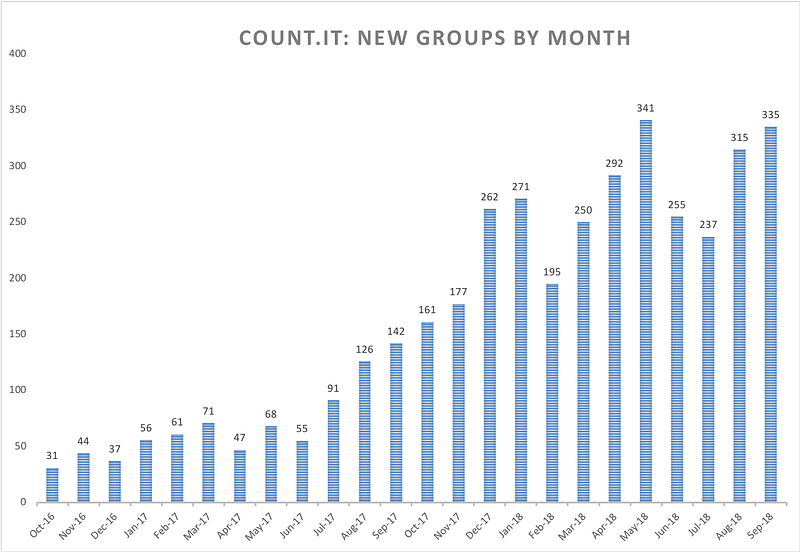
After four years on a starvation diet, Count.It has started to grow. We’re barely holding it together on our tiny, bootstrap budget, but the market signals are increasingly clear and promising.
12%: COMPOUND MONTHLY GROWTH FOR THE LAST 18 MONTHS
11: NEW GROUPS SIGNED UP EVERY DAY IN SEPTEMBER
2494 NEW GROUPS SIGNED UP Q1-Q3 2018
These groups were from 186 US metro areas, and 37 countries. Most are small US companies—law firms, tech startups, and ad agencies—but we also get groups from large multinationals, non-profits, and even just large groups of friends. Among other clients are Lindt, the British chocolate maker, IBM, Siemens, the Goldman Sachs legal department, the Bend, Oregon Police Department, the Stephen J. Mather High School in NYC, and all of the Hyatt hotels in the San Francisco Bay Area!
In seven words: Count.It powers fitness tracker-driven activity challenges for groups.
This is not a new concept — wearables were hot ages ago, and pedometer challenges are ancient. But tech markets often happen slowly before they happen fast, and this market is picking up speed. For the record, our mission is broader than challenges alone. I might have replaced “activity challenges” with “wellness” in the description above, but challenges are our foundation, and it’s where we are now. Over and over, we hear from groups who are looking for a simple, affordable way to run a fun, healthy challenge with fitness trackers, and/or to integrate tracker challenges into their ongoing wellness programming.
A few stats on the 300-plus groups that sign up every month:
5%: UPGRADE TO OUR PAID “PRO” SERVICE
43: AVERAGE NUMBER OF USERS PER PRO GROUP
1094: BIGGEST PRO GROUP (SIEMENS PLM SOFTWARE)
$2.50: AVERAGE $ FEE / PRO USER / MONTH
The vision for Count.It rests on the insight that activity sensors are now a pervasive part of our modern digital infrastructure, and that, done right, “wellness programming” for this infrastructure can strengthen communities and improve personal health. Tracker challenges have been a feature of enterprise wellness programs for some time, but today’s “step challenge” is a primitive version of the experience to come, i.e. when virtually all adults will wear or carry multiple sophisticated activity sensors. That future is not hypothetical, nor is the demand for effective programming around wellness and employee “engagement.”
115 MILLION: WEARABLES SOLD IN 2017.
$50 BILLION: GLOBAL CORPORATE WELLNESS MARKET 2017
$74 BILLION: ESTIMATE OF US “EMPLOYEE ENGAGEMENT” MARKET
If these market numbers are big, Count.It is not. We have zero full time employees, and no marketing budget. From our office in New York, I run a team of six freelancers, mostly engineers. We’re closing in on $6K a month in recurring revenues against expenses of $10–15K. We should be spending double that.
Count.It is more a proof of concept now than it is a proper business, but the current scale is not the full story. With 200 paying clients, on a reasonable budget, the company breaks even. With 500 clients, the business nets $1 million in EBITDA. That’s one tenth of one percent of the 500K private firms in the U.S. with 10 to 1000 employees, and that doesn’t include US non-profits, churches, and schools, etc. — or any groups outside the United States. If Count.It reaches a critical mass of the TAM, its revenues could be in the hundreds of millions.
Whether or not Count.It gets there, I believe that such a platform will emerge. This may be a standalone business, or it may be built or owned by a business in a related market.
To give some sense of the early experience of Count.It, check out this one minute case study video.
About the competition…
- There is no clear leader for group challenges in the consumer or SMB market. We compete with companies like Stridekick, DietBet, IncentFit, Walker Tracker, My Inertia, etc. These are not household names. Fitbit has a significant B2B wellness business, but their platform is “closed,” requiring all participants to use Fitbits, and their strategy is unlikely to change.
- The other top B2C wearables/apps (Garmin, Misfit, Strava, RunKeeper, etc.) provide social features and challenges, but they are designed primarily for personal use, and do not map well to larger groups or B2B applications. Strava, the most interesting of the lot, is focused on serving performance athletes, and has said it is not interested in the B2B wellness market. Both Garmin and Fossil/Misfit have chosen Count.It as their preferred partner in the SMB market.
- The enterprise wellness market is big, but tracker-driven challenges are one of many features in these programs, which are designed to reduce healthcare costs more than to shift group culture over time, and they must meet complex (read: conservative) enterprise requirements.
- Last, inspired by Oscar, many payers now integrate fitness tracker goals and rewards into their offerings, but, again, these are focused on the individual member experience, and remain a small piece of a larger product offering. We do not expect the big payers to lead the way in innovative social programming for wearables.
There is more room to innovate in this market, as well as growing, unmet demand for an effective product.
I founded Count.It in late 2014, and it grew out of a prior startup, SocialWorkout.com. Since launch, Count.It has been my full time job, though for much of 2015 it was on the back burner as I spent time working for the New York Times researching a new wellness vertical. I’ve been in this market in various forms, full time, for nearly ten years; and I’ve personally invested $500K+ in the business.
Before Count.It, I co-founded Apartment Therapy Media, which draws 30 million unique visitors a month and is one of the top indie media companies in the U.S. In prior lives, I covered tech as a staff writer at Fortune magazine, and I spent five years in Silicon Valley as a new media exec at Knight Ridder, then the second largest U.S. newspaper company. I have an MBA from HBS, and a masters in journalism from the Columbia j-school.
What’s the ask? Count.It has potential, and I want to see it realized. I’m seeking investment, and/or strategic help from partners in related businesses.