Wearables at Work: How to Run an Office Fitness Challenge that Doesn’t Suck
You want your office to be jumping with positive energy. The kind of place people want to work, where nobody ever takes a bogus sick day.

You want your office to be jumping with positive energy. The kind of place people want to work, where nobody ever takes a bogus sick day.
Friday happy hour? ✅
Brown bag lunches? ✅
Those are great, but maybe you want something not strictly related to food and beer.
Fitbit challenge anyone…?
Welcome to human resources management in the age of wearable devices and social computing. Every new smartphone sold today is a sophisticated activity tracking device, and soon virtually every watch sold — not just fancy “smartwatches” — will include pedometer functionality too.
A growing body of evidence suggests these devices can be powerful office culture building tools.
One recent study found that employees participating in wearables-driven challenges and rewards programs report an 8.5% increase in productivity, and a 3.5% increase in job satisfaction.
At Count.It we are repeatedly amazed at the communal energy unleashed by activity challenges — and the obvious improvement in office vibe.
OK, but how to launch tracker-driven programming in a way that’s not lame, creepy, prohibitively costly, and/or that doesn’t bury you in horrific new administrative tasks? And how to make it not just a one time thing, but rather something that builds healthy office habits over time?
Read on grasshopper.
Overview
There are two basic things to consider when launching a wellness challenge program with trackers. First, the actual wearable device or smartphone app, and, second, the online platform. That is, the software that will transform all those streams of activity data into an inspiring personal and/or group experience. The hardware gets all the attention, but, over time, the software will likely represent a bigger investment — and it’s also likely the bigger factor in the effectiveness of your program.
NOTE: If you’re looking for guidance on choosing and buying a tracking device or app, please check out both our live rankings of fitness trackers used on Count.It, AND our forthcoming device buyer’s guide for wellness programs.
Wearable-driven online wellness platforms now come in a number of shapes and sizes.
Many big U.S. companies, and even some health insurers, now offer rewards to employees or members for being active. At the “enterprise” level, these challenge platforms are bundled with a variety of other programs, and must comply with federal health regulations. Unavoidably, enterprise solutions tend to be more complex, and carry high price tags, all of which places them off limits to any but the largest U.S. or global companies.
At the other end of the spectrum, a few brave companies offer tracker-driven challenge/reward programs designed for smaller companies as well as non-profits, schools, churches, or any motivated community group.
For the enterprising manager or HR boss looking to do something fun, healthy, and affordable for the office, what’s the best choice?
Key Features
To be a player in the online social activity tracking, any platform needs a number of key features:
- Device Agnostic: The platform should work with any and all of the top activity trackers. The wearable tracker market is exploding. Nevermind Fitbit, say hello to “smartwatches” from Fossil, Timex, and Casio! You can no more run a tracker program expecting everyone to use a single brand of tracker than you would run a tennis tournament demanding that everyone play with the same brand of racket.
- Goals & Challenges: Game mechanics are the secret to engagement: What are the goals, and how are they presented? A good platform should support the easy creation of a range of individual and community goals and “challenges” that are both achievable and inspiring.
- Teams: It takes a village! Personal goals are great, but research suggests that small social groups tend to drive maximum individual performance around behavior change.
- Rewards: While intrinsic rewards provide much of the motivation, a good platform will provide a collection of compelling, customizable extrinsic rewards, and help to automate the delivery of these, and any company-created rewards.
- Reporting: If you’re going to spend time and money on a trackers program, you certainly should track the results! Any legit platform should offer admin reports and analytics.
Most decent tracker platforms offer at least a few of these features, and some offer them all, albeit in various degrees.
The Contenders
The following is our list, presented in alphabetical order, of the top players in corporate wellness platforms for smaller and medium sized businesses. Where possible, we have included pricing information and key features. We will update this round up regularly, and invite all readers to submit further data and/or platforms for consideration.
COUNT.IT
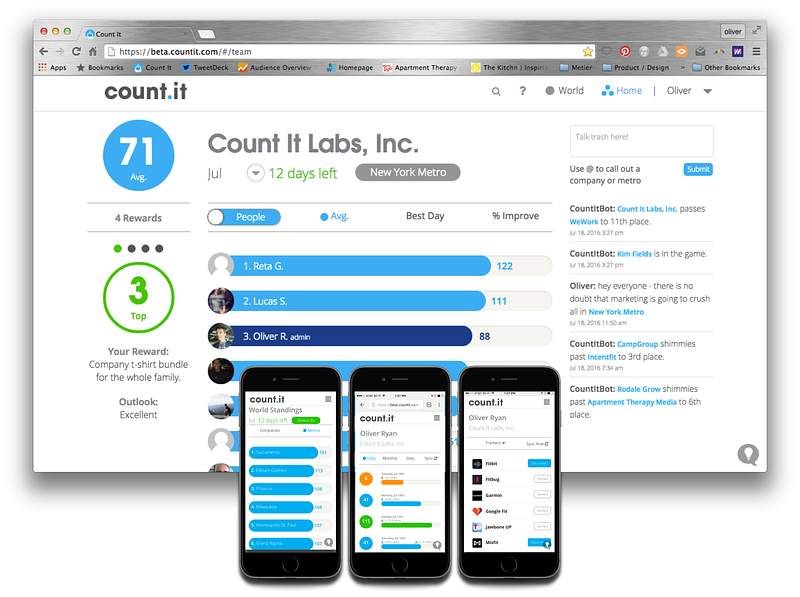
Launched in 2015, Count.It is web native, mobile, and works with the top activity trackers. It is designed to simplify and improve any community activity challenges, and automate corporate gym reimbursement and incentive programs. Count.It supports internal teams, and a range of “push button” goals and rewards. It also allows for inter-company challenges.
- Price: $2 / user / month, paid month-to-month. No setup or cancellation fees.
- Pros: Social and user-friendly for players and admins. Supports inter-company challenges, and full integration with Slack and Hipchat. Automated rewards include gift cards from Amazon and Chipotle. Newest, lowest cost offering on the market.
- Cons: Less conventional wellness service than wearables-driven challenge platform, the system does not support points for non-tracker-collected data, such as classes or biometric screenings, etc.
FITBIT
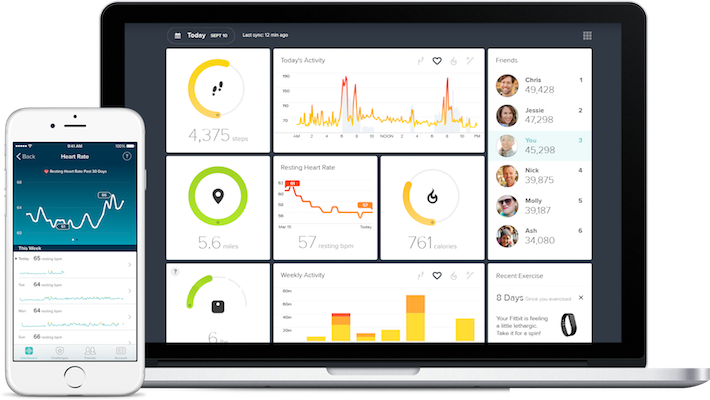
Fitbit owns 22% of the global fitness tracker market, and, in recent years, has aggressively entered into the corporate wellness market, selling devices in bulk and building out its own “group wellness” platform.
- Price: Contact Fitbit for pricing (Requires bulk purchase of Fitbit devices.)
- Pros: Great consumer app, motivating email notifications, and connectivity to social media.
- Cons: Works only with Fitbit devices, expensive, and lacks incentives or rewards.
HUBBUB HEALTH
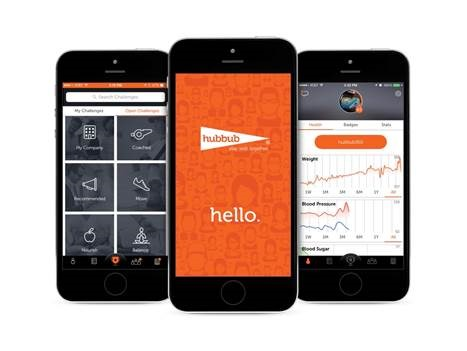
A veteran player in the wellness market, Hubbub offers a range of services beyond activity challenges, including biometric screening, challenge “coaches,” smoking cessation, and educational content.
- Price: $3 / user / month for 100 person company. (Volume discounts likely available.)
- Pros: Bundles a menu of services within the product for a competitive price.
- Cons: Many moving parts. Requires pro-active users to maintain engagement.
STRIDEKICK
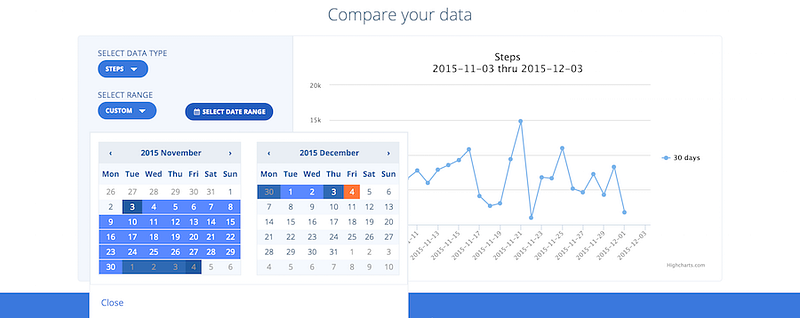
Built to support consumer fitness challenges, the Stridekick platform and related app support are organized around user-generated challenges with various formats, map challenges, leaderboards, and an individual streak challenge.
- Price: $5 / user / month for base “Champion” service, more for “Enterprise” service.
- Pros: Basic service includes a group portal, group messaging, and data downloads. Stridekick makes it easy for corporate users to also initiate challenges with friends and family.
- Cons: The basic “Champion” service does not include support for teams. The service somewhat less optimized for corporate settings.
WALKER TRACKER
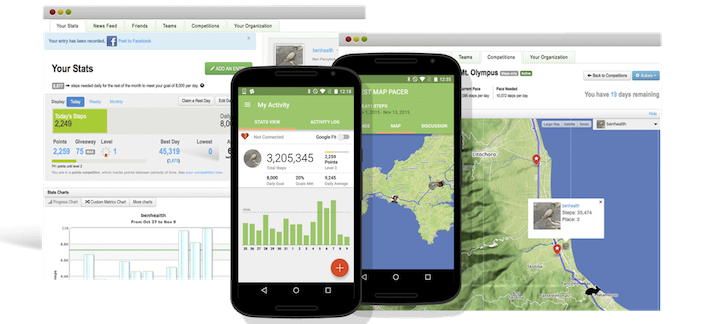
This twelve year old platform allows for lots of company customization and personalization. Users get a smartphone app that allows them to log data and view stats on their phone, and the platform supports strong communications options for admins.
- Price: $2750 / year for under 300 users; $1495 for a single challenge of up to 12 weeks
- Pros: Many different options for customizable challenge formats including virtual map challenges and single-challenge events.
- Cons: Costly initial buy in, and support for many options creates complexity in user experience.
WALKINGSPREE
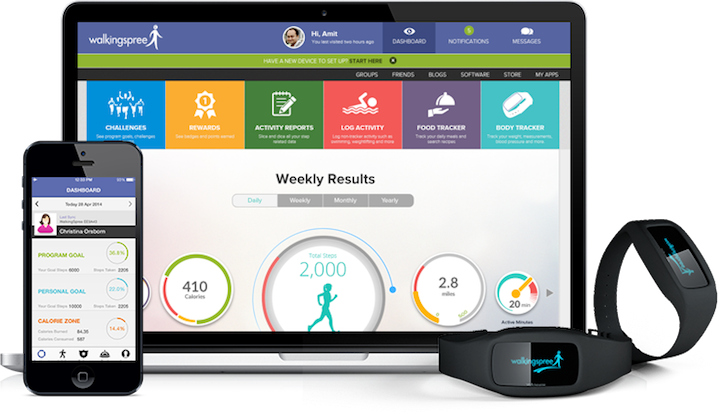
Similar to Walker Tracker, Walkingspree, which launched in 2006, provides clients with a co-branded portal and mobile app. The program uses a “points” system that awards users based on participation, and hitting personal and team goals. Notable challenge formats include Zombies-style chase scenarios and healthy eating challenges.
- Price: $3 / user / month, $1000 set-up fee
- Pros: The app offers a wide variety of creative, quarterly challenge templates so you can choose the one you think best fits your company culture.
- Cons: The points system can be confusing.
OTHERS TO CONSIDER

Conclusion
The early novelty of fitness trackers may have started to fade, but the wearables-driven wellness era is still in its infancy. At Count.It we’re committed to finding ways to create personal and group experiences that are as fun and healthy and human as possible. We’re eager to share our experiences, and hear yours. If you’ve had success (or not!) running sensor-driven wellness programs in YOUR workplace, send us your stories!
Count.It is a software platform for smart, healthy workplaces. Check us out on Medium, Twitter, or on our site.