One Giant Step Forward
Count It Labs has launched a funding campaign on SeedInvest. That means we’re inviting the whole world to invest in us. Here’s why, and…
Count It Labs has launched a funding campaign on SeedInvest. That means we’re inviting the whole world to invest in us. Here’s why, and how, and for whom…
There are roughly half a billion “wearable” devices in the world today — mostly fitness bands and smart watches. Whether we are smitten or skeptical, roughly one in six of us sports one. Given that, it may seem like wearables have already jumped the shark. Actually, it’s still early in this trend.
By 2020, 200 million new devices will ship every year. We’re on the way to a world in which ever smaller, ever smarter sensors will be built into ever more “wearable” things: Watches, bracelets, necklaces, headphones, hearing aids — never mind smartphones.
The existential question for sensible people: Why? And, will it help?
Some will answer this optimistically, and others apocalyptically. I have both reactions, yet mainly believe that the path is ours to shape, for better, or worse.
My company is at the center of all this. For the past three years, our software has powered fitness challenges for companies and community groups. These groups are coming to us because they are wrestling with two other big trends: The rise of chronic health problems, i.e. diabetes, obesity, and heart disease, and the (perhaps related) challenge of keeping an increasingly sedentary, screen-focused workforce happy and productive.
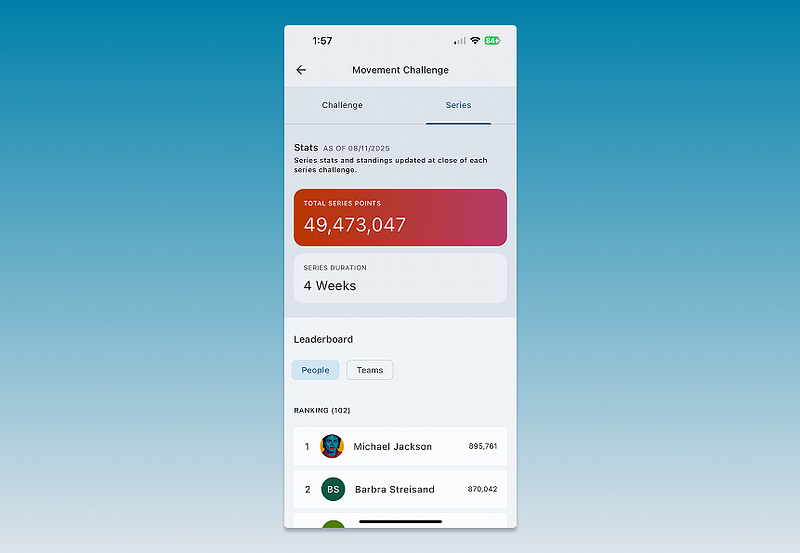
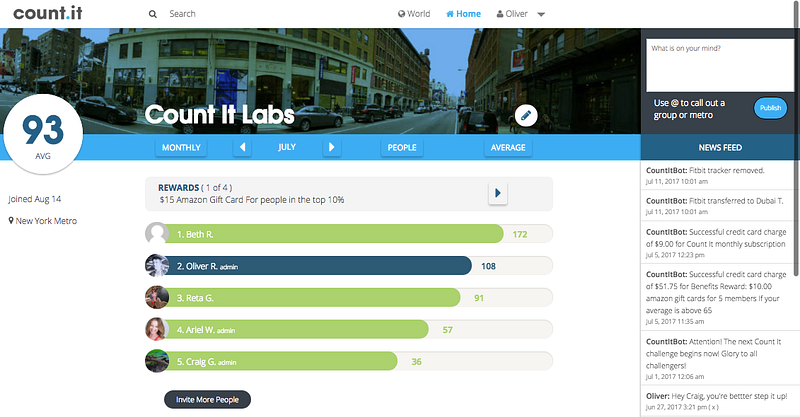
Count.It makes it easy, and very affordable, for these groups to run non-lame wellness programs driven by all manner of fitness tracking app or wearable. At the most basic level, we automate the old office step challenge, or corporate “gym reimbursement” program. In a broader sense, we’re developing healthy culture programming for a sensor-laden world. All you need is an app or a fitness tracker, and you can join.
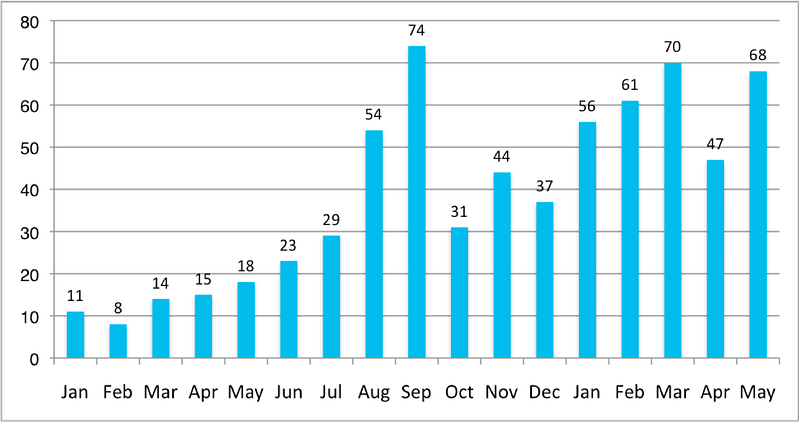
Roughly two new companies or groups now join our platform every day. In recent weeks, we’ve fielded calls from the United Kingdom to the United Arab Emirates. In England, our partner, TPS Consultants, is deploying Count.It to office parks to encourage “sustainable commuting.” A consortium of groups in El Paso, Texas wants to use Count.It to run a citywide fitness challenge.
On Count.It, everyone connects an app or wearable tracker, and can instantly see how active they are relative to others in their group — and how active their group is collectively relative to other groups on public leaderboards, or in our “#leagues.” Today the data and challenges are simple: We track steps and cycling miles. Tomorrow the metrics will include swimming, sleep, and other activity types, as well as “biometrics,” like heart rate. The challenges will become both more personalized, and more compelling.
And, yes, people will get to choose what data to share, and what to keep private from their friends, co-workers, bosses, or the rest of the world. That’s the part where we get to shape the path.
It’s amazing to see what people do when they have something to play with. In Provo, Utah, InsideSales.com, a 500 person software company, mashed up Count.It with a March Madness bracket website to create an internal corporate tournament nearly as competitive as the real thing. In San Francisco, three Hyatt Hotels formed a league to battle each other—live streaming the standings onto big screens in their employee cafeterias. We have a public school in New York piloting the platform, and a police department in Oregon. The possibilities are many.
We’re also attracting interest from other industry players: In June, we launched three “white label” partners that are now reselling Count.It under their own brands. Meanwhile, two big device makers, Garmin and Fossil, have chosen us as their preferred vendor for SMB wellness.
So, we have paying clients, distribution partners, and favorable macro trends. That said, we are not yet to the promised land. Over 700 groups have signed up on the platform, and roughly 80 have upgraded to our paid, PRO service. That’s helped push our revenues up steadily, but they remain tiny — less than $100K per year at our current run rate.
The hard truth: Wellness is a discretionary benefit, and companies, particularly small companies, have limited budgets for it. Selling wellness to “SMBs” has always been a tough business — the domain of scrappy mom-and-pop consultants, or health insurance brokers who often give away limited programs in hopes of closing the bigger insurance sale. The big money is in health insurance, and wellness has always been a slightly milk-toasty afterthought.
However, wellness in the U.S. is now an $8 billion afterthought, projected to grow at 8% per year through 2021. That’s an incremental $640 million pouring into the US market each year, which is not so milk-toasty. Also, while tough, the “SMB” market offers short sales cycles, more room to innovate, and less competition. There are about 500,000 “white collar” firms in the U.S. with between 10 and 1,000 employees. If we can crack the code with mid-market companies, we win a very big market, and we put ourselves in a position to disrupt the slower moving, higher cost “enterprise” vendors. We may also then become an attractive target for the even bigger, and slower moving, insurance companies, i.e. the big money.
If that breakthrough moment is going to happen, for us, or anyone, I believe now is the time. Sensors and SaaS are together making high quality, low cost, wellness programming possible at scale. With scale also comes the tantalizing prospect of a network effect for an open platform like ours. The more groups that join, the lower the incremental cost per group, the richer the collective data, and the more compelling the public challenges. Also, the harder to duplicate. We can already glimpse a world in which tracker-driven wellness is an “always on” office staple, not just an fun-but-hokey annual challenge, or an eminently ignorable Fortune 500 benefit. Companies, large and small, want a platform to energize their office culture, and provide feedback on the health of their community. We want to be their default choice.
To get there, we have a lot more work to do, both on the product, and in sales and marketing. We’ve made it a long way with a bare bones team. To win, we need to do more, faster. And, for that, we need capital.
Enter the brave, new world of “equity crowd-funding.”
A long time ago, like in 2013, I was working out of a co-working space in Soho. Whenever I leaned back in my rolling chair, I bumped into one of the co-founders of another small start-up. These guys clearly had their act together — a bunch of young Wharton MBAs with above average focus and discipline. I was impressed then, and not surprised later, when SeedInvest went on to be one of the leaders of the equity crowd-funding movement. When it came time to raise some money, I emailed them. It somehow felt right that, if Count.It was going to seek funding, we’d do it in the newfangled way. I was delighted when these guys, who accept only ~ 1% of applicant companies, invited Count It onto their platform.
It all seemed right and exciting, that is, until I realized this meant actually asking people, including friends, for money. It’s one thing to stubbornly tinker away on a dream, funding it from one’s savings. That’s crazy enough. It’s quite another to put that crazy fully on display for all the world to see, and to ask for other people’s money, and help.
So, this is where I paraphrase the famous ad attributed to Ernest Shackleton, the polar explorer:
Investors wanted for hazardous venture. Low budgets, bitter disappointments, long months of uncertainty. Positive return doubtful. Honour and modest riches in event of success.
Let’s be clear, Count It Labs is a long shot, and this is not an investment for most people, and also not an obligatory “friend tax.” Really. This is an investment for people with a high tolerance for risk, who are seriously interested in the potential of using technology to help build a healthier culture.
This may also be a smart investment for the companies using our platform today. Thanks to our Investor Perks, in fact, a client, or partner, can convert what would otherwise be ongoing service fees into an up front equity investment. That’s a win-win.
A final story: I once shared a taxi from the airport with a NYC couple who had worked for a big local power utility. I told them about Count.It, and the man talked about how he’d gone to the top of the organization asking for a standing desk — and had been turned down. He mentioned that one day at work a a co-worker had a heart attack and died in the office. “They carried him out,” he said, “and everyone just kept working.”
We sat for a moment, and then he said, “You got to take care of your people.” I realized instantly that he had nailed our mission.
Take care of your people!
That’s our challenge, and we’re looking for capital, and a few smart people to join us. If any of the above speaks to you, shoot me a line, or click over to our profile page at SeedInvest!

Count.It is offering securities under Regulation CF and Rule 506(c) of Regulation D through SI Securities, LLC (“SI Securities”). The Company has filed a Form C with the Securities and Exchange Commission in connection with its offering, a copy of which may be obtained at: Count.It: https://www.seedinvest.com/count.it/seed.