Count.It Is Growing…Up
We’ve been hustling for a long time, and the numbers are beginning to tell a promising story…
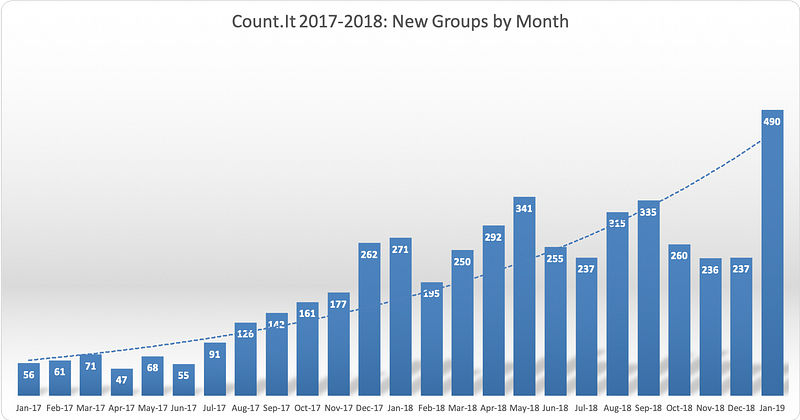
We’ve been hustling for a long time, and the numbers are beginning to tell a promising story…
490: NEW GROUPS SIGNED UP IN JANUARY.
9.4%: COMPOUND MONTHLY GROWTH FOR THE TRAILING 24 MONTHS
There are now 5000-plus groups on the platform from 186 US metro areas and 37 countries. Most are small US companies — law firms, tech startups, and ad agencies — but we also get groups from large multinationals, non-profits, and even just large groups of friends.
Just in the last week we have seen groups join from Disney, Plantronics, Accenture, Hyundai, Grant Thornton, and the Office of the Chief Technology Officer of the District of Columbia. Other notables on the site include Lindt, the British chocolate maker, Hyatt Hotels, IBM, Siemens, Goldman Sachs, the Bend, Oregon Police Department, and the New York City Dept. of Education.
In seven words: Count.It powers fitness tracker-driven activity challenges for groups.
This is not a new concept — wearables were hot ages ago, and pedometer challenges are ancient. But tech markets often happen slowly before they happen fast, and this one is picking up speed. Over and over, we hear from groups who are looking for a simple, affordable way to run a fun, healthy challenge with all the different types of fitness trackers their users might have, and/or to integrate tracker challenges into their ongoing wellness programming. A few stats on these groups:
43: AVERAGE NUMBER OF USERS PER PRO GROUP
1094: BIGGEST PRO GROUP (SIEMENS PLM SOFTWARE)
5%: UPGRADE TO OUR PAID “PRO” SERVICE
$2.50: AVERAGE $ FEE / PRO USER / MONTH
The vision for Count.It rests on the insight that activity sensors are now a pervasive part of our modern digital infrastructure, and that, done right, social programming for this infrastructure can strengthen communities and improve personal health. Our mission is broader than challenges alone, but challenges are our foundation.Tracker challenges have been a feature of wellness programs for some time, but today’s step challenge is a primitive version of the experience to come, i.e. when virtually all adults will carry multiple sophisticated activity sensors. That future is not hypothetical.
115 MILLION: WEARABLES SOLD IN 2017.
$50 BILLION: GLOBAL CORPORATE WELLNESS MARKET 2017
$74 BILLION: ESTIMATE OF US “EMPLOYEE ENGAGEMENT” MARKET
I believe one or two standard device-agnostic, social platforms will emerge to provide wellness data and challenge programming to groups, at low cost. To give some sense of the early experience of Count.It, check out this one minute case study video.
I believe the market will be won by startups working today in the wilds of the consumer “social” and SMB markets—not by existing personal fitness app makers (MyFitnessPal, Strava), or wearable device manufacturers (Fitbit, Garmin), or enterprise wellness companies. Here’s the general competitive landscape…
- There is no clear leader for group challenges in the consumer or SMB market. Count.It competes with companies like Stridekick, DietBet, IncentFit, Walker Tracker, My Inertia, etc. These are not household names. Fitbit has a significant B2B wellness business, but their platform is “closed,” requiring all participants to use Fitbits, and their strategy is unlikely to change.
- The other top B2C wearables/apps (Garmin, Misfit, Strava, RunKeeper, etc.) provide social features and challenges, but they are designed primarily for personal use, and do not map well to larger groups or B2B applications. Strava, the most interesting of the lot, is focused on serving performance athletes, and has said it is not interested in the B2B wellness market. Both Garmin and Fossil/Misfit have chosen Count.It as their preferred partner in the SMB market.
- The enterprise wellness market is big, but tracker-driven challenges are one of many features in these programs, which are designed to reduce healthcare costs more than to shift group culture over time, and they must meet complex (read: conservative) enterprise requirements.
- Last, inspired by Oscar, many payers now integrate fitness tracker goals and rewards into their offerings, but, again, these are focused on the individual member experience, and remain a small piece of a larger product offering. We do not expect the big payers to lead the way in innovative social programming for wearables.
Bottom line, there is a lot of room still to innovate, and clearly growing, unmet demand for an effective product. We see a big opportunity in this market. If done well by a good company, we also believe a great platform could help push modern office culture in a more social, supportive, healthy direction.