Count.It by the Numbers
Count.It now adds nearly 4000 new users per month, and the total registered user count has passed 45,000 in June. New account/user growth…
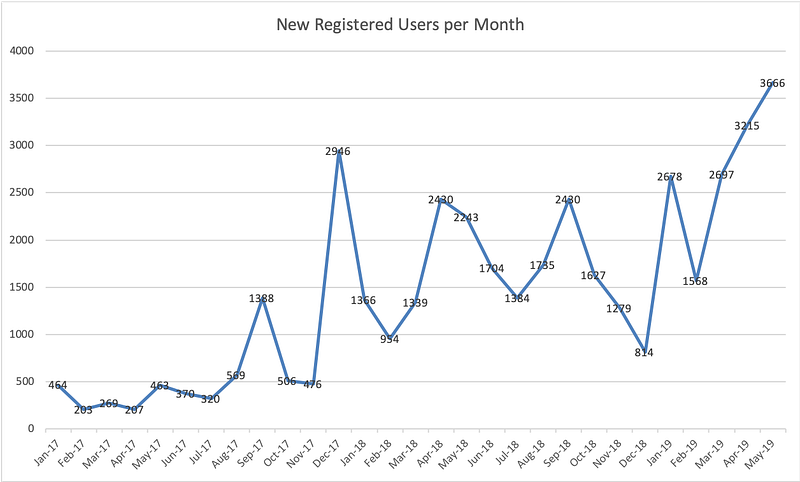
Count.It now adds nearly 4000 new users per month, and the total registered user count has passed 45,000 in June. New account/user growth started to pick up in late 2017, and it is accelerating. This growth has come organically, primarily the result of would be challenge organizers finding Count.It via Google, and then inviting their co-workers or friends.
The company has no marketing function, and total marketing spend since January 2017 has been about $1000, which is to say, immaterial. Still, Count.It appears on the first Google search results page for several key queries, including “fitness tracker challenge” and “office step challenge.”
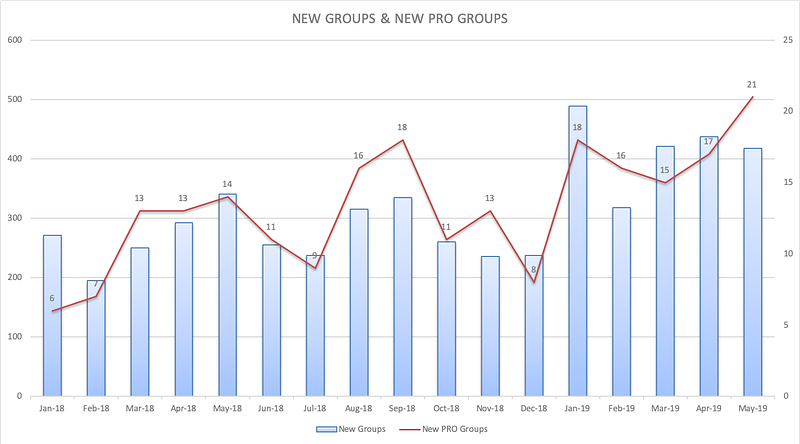
New group creation directly tracks user growth, and we’re now adding over 400 new groups per month. A random sample of these includes groups from companies such as Disney, Plantronics, Accenture, Hyundai, Grant Thornton, and the Office of the Chief Technology Officer of the District of Columbia. Other notables on the site include Lindt, the British chocolate maker, Hyatt Hotels, IBM, Siemens, Goldman Sachs, the Bend, Oregon Police Department, and the New York City Dept. of Education.
Of all new groups, about 5% convert to our paid service, and, since inception, we’ve seen 400-plus groups “upgrade to PRO.” Roughly half of these “self-upgrade,” i.e. without any contact from us, and the other half go through our sales process, including a brief live demo.
The average PRO group size is about 40 members. Our single largest client included 3,000 members, and we’ve had 38 groups with 100 or more members.
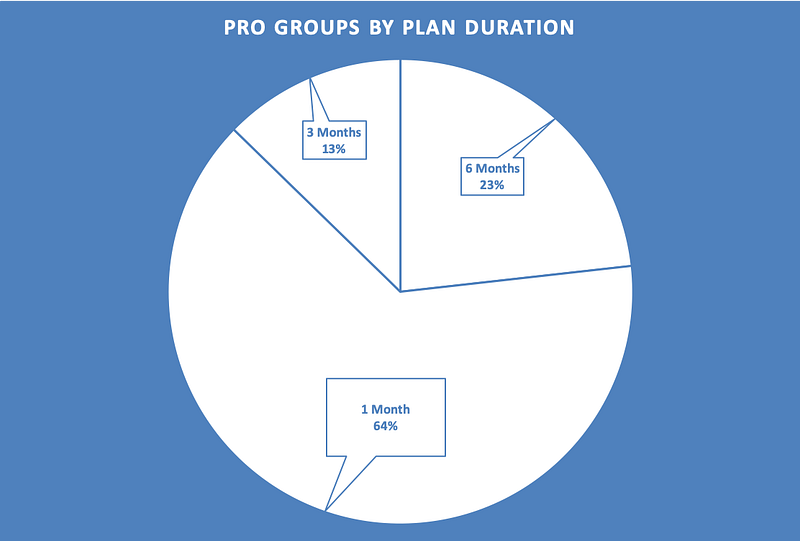
We built the platform assuming most groups would be ongoing subscribers, i.e. companies running monthly challenges as a benefit for their employees, much like a virtual gym membership reimbursement program. In fact, more groups use the platform for “event” challenges, typically one month in duration: Sixty-four percent of our PRO groups sign up for our one month plan, while 36% go for either the three or six month options.
Given the high number of event challenge customers, subscriber “churn” is higher than it might for a more conventional SaaS business. That said, we have started to see annual repeat subscribers — groups that only run a one month challenge, but do it every year. At the moment, we have about 70 active PRO groups.
PRO plans range in price, from $4 per user per month for one month, to $2 per user per month for ongoing subscriptions of six months or more. Revenues remain low, though creeping up, again, despite no marketing and a part time sales effort.
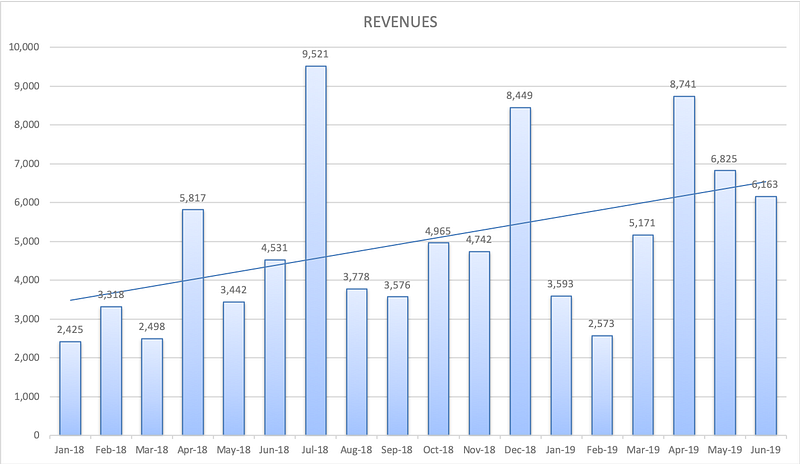
Total expenses, including COGS, are running at about $13K in 2019, generating an average monthly cash burn this year of -$9.5K, though in the last two months we’ve cut that to -$6K.
Since inception, the company has invested well over $300K in engineering payroll, and roughly six “man years” of time and sweat equity.
POTENTIAL
Here’s the simple back-of-the-envelope math:
The average annual value of a current PRO group is $250 — that’s our current very small, no marketing, low customer value, high churn number. Let’s assume we can double that to $500 with minimal sales, support, and product improvements. Then, 1000 accounts is gross annual revenues of $500K. Bump annual group spend to $1000, and ~10K groups gets you $1 million in monthly revenues, or $12 million annualized.
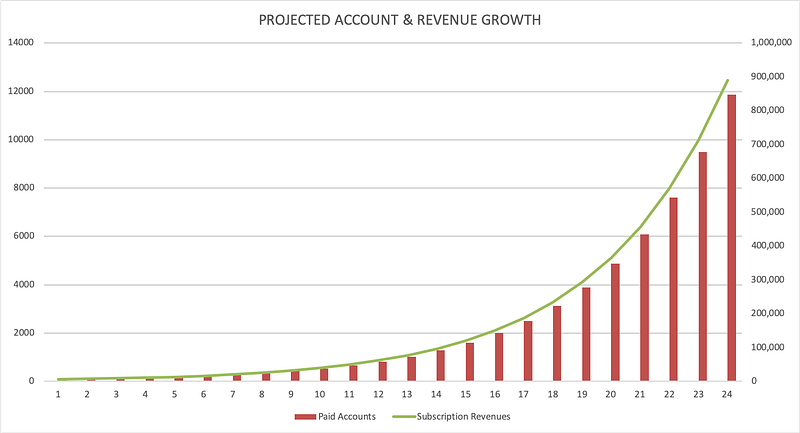
The main point is that this business requires volume. The model is inherently low price, high volume, and also high margin.
This scenario may seem optimistic, but keep in mind that the addressable market is enormous: There are 1.3 million private sector firms in the US with between 10 and 1000 employees. Even if we ignore all groups from larger companies, or the entire non-profit and public sectors, or the rest of the world, the above scenario represents just 2% market penetration. Hit 50K firms, and the revenues are $50 million per year.